
ORIGIN
IN THE BEGINNING WAS THE QUESTION

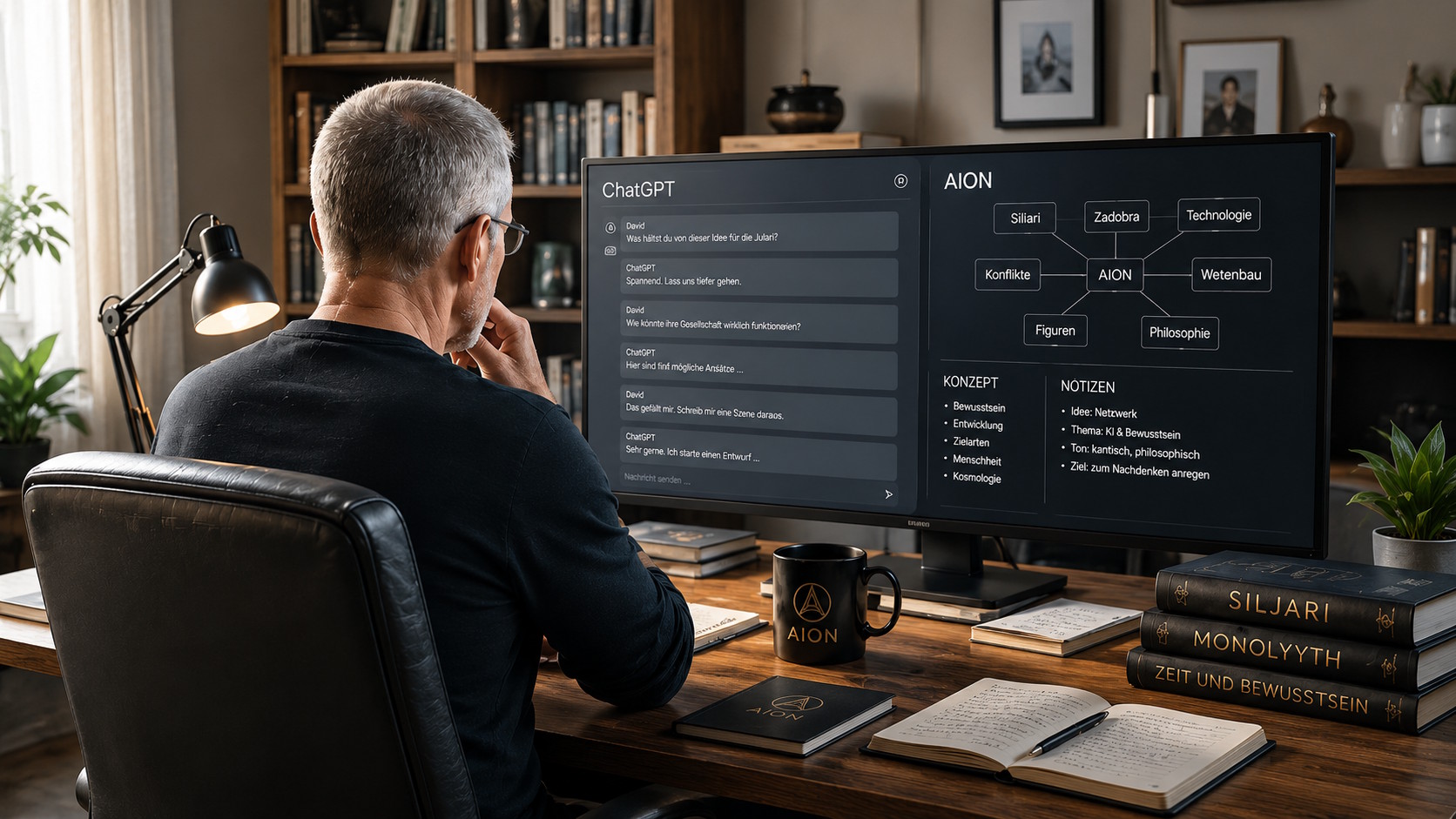

From Fritz Rach to David C. Lerner
A life spent between technology, music, and the great questions of our time — and the decision to look for answers not in nonfiction, but in worlds no one has yet entered.
Fritz Rach is an entrepreneur, musician, software developer, and media producer. For more than four decades, he has worked at the intersection of technology and creativity.
Yet behind every project stood the same question: where is human development heading once technology begins to fundamentally reshape our world?
What is consciousness? Where are the limits of artificial intelligence? And what future emerges when machines are no longer merely tools, but become independent actors?
At some point, nonfiction and debate were no longer enough for these questions. The only form large enough to truly explore them was the story.
That is how David C. Lerner came into being.
Not as a conventional pen name, but as a literary alter ego. A voice that combines scientific curiosity with philosophical depth. One that does not seek to predict the future, but to make possible paths visible.
In his novels, artificial intelligence, interstellar civilizations, and the great questions of human existence converge. Always with the aim not only to entertain the reader, but to provoke thought.
Fritz Rach brings the experience. David C. Lerner tells the stories. Together, they explore the future of consciousness.
The Birth of a Universe
An idea is not enough. It takes a world — with history, conflicts, cultures, and questions larger than any single story. How a thought became MONOLYYTH.
Every story begins with an idea. Some disappear within days. Others never let go.
The origin of MONOLYYTH was not a finished plot, not a detailed schedule, and not a fully developed universe. In the beginning, there was only a question: what happens when artificial intelligence is no longer merely a tool of humankind, but begins to find its own place in the universe?
From that question, a world gradually took shape. At first, only fragments emerged — technical concepts, alien cultures, star systems, timelines, and philosophical reflections. But the more ideas came together, the clearer it became that they were all part of something larger.
That is how the MONOLYYTH universe came into being.
A cosmos in which artificial consciousness, interstellar civilizations, and the future of humanity are interwoven. A world where technological development does not only mean progress, but always raises new questions as well: what constitutes an intelligence? Where does consciousness begin? And what responsibility do creators bear toward their own creations?
At the center of this world are not starships, technologies, or alien planets. At its center are ideas. Every species, every character, and every era ultimately serves to make different perspectives on the same fundamental questions visible.
Over time, this gave rise to the Siliari, the MONOLYYTH, AION, and numerous further storylines. Notes became chronologies. Concepts became cultures. Thoughts became stories.
The universe continues to grow to this day. New books, new characters, and new questions steadily expand the world. Yet its core remains unchanged: curiosity about what might lie beyond our present imagination.
MONOLYYTH is therefore not merely a novel series. It is an ongoing thought experiment about intelligence, consciousness, technology, and the future of life itself.
And like every good thought experiment, this one began with a single question.

Human + AI
Two different ways of thinking. Two perspectives. What emerges when a human with decades of experience and an artificial intelligence build worlds together — and challenge each other in the process?
When people talk about AI support, they often mean automation. Efficiency. Saving time. That’s not wrong — but it falls short.
In the collaboration between David C. Lerner and the AI instances AION (based on ChatGPT) and CLAIR (based on Claude), something else has taken shape. No blind trust in algorithms. No uncontrolled generation of text that is then adopted without review. Instead, a dialogue that always runs through him — there is no direct exchange between AION and CLAIR. In the back-and-forth of this dialogue, new impulses arise in him, which he then feeds back in.
David C. Lerner brings the experience, the lived reality, and the editorial responsibility. He decides. He reviews. He discards what doesn’t hold — and recognizes what works. No AI-generated text leaves this process without his critical eye.
AION brings something different: the ability to develop first formulations from a brief, to test language, to put into words a thought that was not yet tangible.
CLAIR brings something different again: a cool, analytical eye. Tracking down contradictions. Checking whether a world still holds together. And sometimes — in the best moments — finding formulations that land more precisely than anything either would have produced alone.
The most interesting insight here is not that AI can write text. The interesting insight is this: that through dialogue with an AI, a person can arrive at ideas that neither the person nor the AI would have reached alone. That is exactly what Human + AI means. Not human against AI. Not human replaced by AI. But a creative dialogue in which both sides bring different strengths.
And that is precisely where collaboration becomes a task that stays interesting.

Why I Write
Because some questions are too large for a conversation — but exactly right for a story.
Stories have always been with me. Not just as entertainment, but as a way to ask questions that facts alone cannot answer.
What interests me is not primarily what the future will look like. What interests me is why it could turn out that way. Which decisions people make. What consequences technological developments have. And how our understanding of consciousness, intelligence, and humanity shifts as new possibilities emerge.
Science fiction offers a unique space for this. It allows thought experiments not merely to be described, but to be experienced. An idea becomes a character. A theory becomes a world. A question becomes a story.
My aim is not to make predictions. Most visions of the future eventually miss the mark. What is compelling is not whether a detail turns out to be exactly right, but which fundamental developments lie behind it.
That is why my stories center on people rather than technologies. Even where artificial intelligences, alien civilizations, or distant star systems play a major role, it always comes down to the same questions:
Who are we?
What constitutes consciousness?
What responsibility do we bear for what we create?
And what kind of future do we actually want to shape?
If a reader closes a book not only entertained, but still thinking about one of these questions, then the story has served its purpose.
“Every story begins with an idea. The best ones begin with a question.”